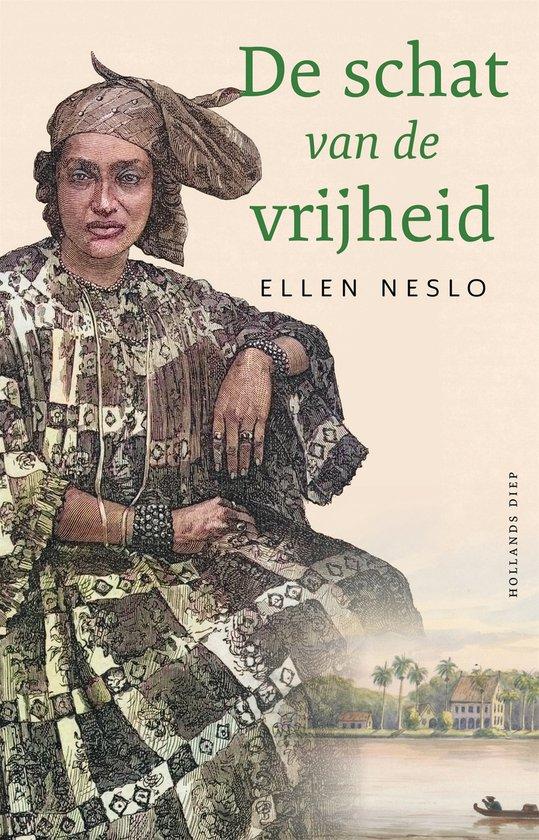
The Treasure of Freedom
A forthright and fascinating contribution to public discourse on slavery, identity and post-colonial heritage.
The Treasure of Freedom is a true story. As historian Ellen Neslo scrutinises her own family history, she presents an in-depth and evocative description of Suriname’s colonial past under Dutch rule. This book is a compassionate attempt at reconstructing the life of one of her ancestors, Paulina.
Elco Lenstra
Paulina (1768-1861) was born into slavery on a sugar plantation along the Suriname River. These are turbulent times during which enslaved Africans flee to the safety of the country’s hinterland, where they gather in Maroon communities. Paulina is a house slave who works and lives in the home of the plantation owner. It is here that she meets the man who would become her partner for life: Klaas van der Meer, a Dutch carpenter who has moved to Suriname to escape the stirrings of revolution in the Netherlands.
Paulina and Klaas have three children. Klaas realises that they are not his own, but the plantation owner’s. In this bizar world, he makes several transactions to purchase Paulina’s and his children’s freedom, buying them first from the owner and then from the Dutch state. The couple goes on to live together in Paramaribo, but never marry. When Klaas passes away, former slave Paulina acquires ownership of various house slaves, while her son even becomes a plantation owner.
This biography, in some ways a tale of reversed fortunes, highlights how the system kept people of colour locked in forever. The Treasure of Freedom lays bare the ties between independence and ambition in a complex colonial society. Can emancipation exist without reproducing oppressive structures? Paulina’s life showcases the many nuances of colonial society.
This book offers a reflection on the past while displaying with intense accuracy how that past reaches into the present.
Neslo’s engaging narrative style immerses the reader in history.
This book sheds light on the volatility of the long term development of slavery.
In recounting this one single life, Neslo validates many more stories.
de Groene Amsterdammer
The book’s layered and ethically complex account stems from the author’s duality as a historian and descendant of slavery. Paulina is not presented as a hero, but as a woman who shifts between the possibilities and limitations of her time.
Caraïbisch uitzicht